
STEM vs STEAM: What's the Difference in Education?
Educators debate adding arts to STEM learning. Both approaches prepare students for future challenges.
STEM focuses on science, technology, engineering, and mathematics, while STEAM incorporates arts into the framework. This integration uses creativity and design thinking to enhance traditional STEM education and problem-solving approaches.
![Classroom with both STEM tools and art supplies available for students]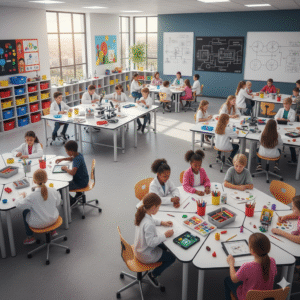 "Classroom with STEM tools and art supplies for student use")
Wondering whether to choose STEM or STEAM for your educational setting? Understanding these two educational approaches can help you make informed decisions about curriculum and classroom design.
What is STEM?
STEM represents an educational approach that combines four distinct disciplines. These fields connect through real-world applications and interdisciplinary learning.
STEM integrates science, technology, engineering, and mathematics into a cohesive learning paradigm emphasizing problem-solving, analytical thinking, and technical skills. This approach prepares students for careers in growing technical fields and complex challenges.
![Students working on a hands-on science experiment with technology] "Students conducting science experiment with technology")
The four components of STEM education include:
- Science: The study of the natural world through observation and experimentation
- Technology: The application of scientific knowledge for practical purposes
- Engineering: The design and creation of solutions to real-world problems
- Mathematics: The study of numbers, quantities, and shapes
STEM education emphasizes project-based learning, collaborative problem-solving, and practical applications of theoretical knowledge. Students learn to think critically and develop solutions to complex challenges using scientific and mathematical principles.
What is STEAM?
STEAM builds upon the foundation of STEM by incorporating a fifth essential discipline. This addition transforms educational approaches and learning outcomes.
STEAM adds arts to the traditional STEM framework, recognizing the role creativity and design play in scientific innovation. This approach uses artistic methods to enhance understanding and expression across all scientific and technical fields.
![Student creating art that incorporates mathematical patterns] "Student creating art with mathematical patterns")
The arts component in STEAM includes:
- Visual Arts: Drawing, painting, sculpture, and digital design
- Performance Arts: Music, theater, and dance
- Language Arts: Creative writing, storytelling, and communication
- Design Thinking: User-centered design, aesthetics, and creative problem-solving
STEAM acknowledges that innovation often occurs at the intersection of technical knowledge and creative thinking. By integrating artistic approaches, students develop a more comprehensive toolkit for addressing complex challenges.
The Differences Between STEM vs STEAM
STEM and STEAM share common goals but differ in approach and emphasis. Understanding these differences helps educators choose appropriate methodologies.
STEM focuses on technical skills and analytical thinking through science, technology, engineering, and mathematics. STEAM incorporates arts and design, emphasizing creativity, innovation, and interdisciplinary connections as essential components of technical problem-solving.
![Comparison diagram showing STEM subjects versus STEAM subjects] "Diagram comparing STEM and STEAM education frameworks")
Key differences between STEM and STEAM include:
| Aspect | STEM | STEAM |
|---|---|---|
| Core Subjects | Science, Technology, Engineering, Mathematics | Science, Technology, Engineering, Arts, Mathematics |
| Approach | Technical, analytical, problem-solving | Creative, design-focused, innovative |
| Learning Methods | Experimentation, data analysis, evidence-based | Experimentation, design thinking, artistic expression |
| Skill Development | Critical thinking, technical proficiency | Critical thinking, творческий, empathy |
| Assessment Focus | Correct solutions, measurable outcomes | Process-oriented, multiple possible solutions |
| Real-world Application | Technical innovation, research and development | User-centered design, creative solutions |
While STEM emphasizes finding correct solutions through scientific method, STEAM embraces multiple solutions and values the creative process. Both approaches develop important skills but emphasize different aspects of learning and innovation.
The Benefits of Integrating STEM and STEAM in Education
Combining elements of STEM and STEAM creates powerful educational experiences. This integrated approach maximizes learning outcomes and skill development.
Integrating STEM and STEAM approaches creates well-rounded learners who excel in both analytical thinking and creative problem-solving. This combination prepares students for diverse career paths and complex real-world challenges requiring both technical knowledge and innovative thinking.
![Student presenting a project that combines technical elements with artistic design] "Student presenting project combining technical and artistic elements")
Benefits of integrating STEM and STEAM approaches include:
-
Enhanced Creativity: The arts component encourages students to think beyond conventional solutions and explore innovative approaches.
-
Improved Problem-Solving: Combining analytical thinking with creative design thinking leads to more comprehensive solutions.
-
Better Retention: Arts integration helps students connect with and remember complex scientific and mathematical concepts.
-
Developed Empathy: Artistic approaches help students understand human-centered design and consider diverse perspectives.
-
Career Readiness: Students develop skills valued across industries, from technical fields to creative professions.
-
Inclusive Learning: Arts integration provides alternative entry points to STEM concepts for diverse learners.
-
Holistic Development: Students develop both left-brain analytical skills and right-brain creative capacities.
Which is Better: STEM or STEAM?
Educators often debate whether STEM or STEAM provides superior educational outcomes. The answer depends on educational goals and contexts.
Neither STEM nor STEAM is inherently "better" than the other. Each approach offers unique advantages that benefit different learners, learning objectives, and educational contexts. The optimal choice depends on student needs, educational goals, and available resources.
Factors to consider when choosing between STEM and STEAM approaches:
-
Learning Objectives: If developing technical proficiency is the primary goal, STEM may be more appropriate. For fostering innovation and design thinking, STEAM offers advantages.
-
Student Population: Some students may thrive with the structured approach of STEM, while others may benefit from the creativity-focused STEAM methodology.
-
Available Resources: Implementation depends on access to appropriate materials, technology, and instructional expertise.
-
Educational Philosophy: Different schools and institutions prioritize different educational approaches based on their overall educational vision.
-
Age Appropriateness: Younger students may benefit more from STEAM's creative exploration, while older students may require STEM's structured technical approach.
Many educational experts recommend taking a balanced approach, incorporating elements of both methodologies to support comprehensive student development and prepare students for diverse future challenges.
Why is STEAM Growing in Popularity in Schools?
STEAM education has gained significant momentum in recent years. Several factors drive this increasing adoption across educational institutions.
STEAM's popularity has grown due to recognition of creativity's role in innovation, employer demand for creative problem-solvers, research supporting arts integration benefits, and the success of STEAM programs in engaging diverse learners and addressing complex challenges.
Key factors driving STEAM's increasing adoption:
-
Industry Demand: Employers increasingly seek candidates with both technical skills and creative abilities to solve complex problems.
-
Research Support: Studies demonstrate that arts integration improves engagement, retention, and understanding of STEM concepts.
-
Innovation Success: Many technological breakthroughs result from combining technical knowledge with creative thinking and design approaches.
-
Student Engagement: The arts component makes learning more accessible and engaging for diverse learning styles and interests.
-
Holistic Development: Educators recognize the need to develop both analytical and creative capacities in students.
-
Real-world Problem Solving: Complex challenges like climate change and public health require innovative approaches that blend disciplines.
-
Career Preparation: STEAM prepares students for emerging careers that don't fit neatly into traditional categories.
As schools recognize the value of creativity in technical fields, STEAM continues to expand as an educational approach that develops well-rounded, innovative thinkers.
How Can Classroom Furniture Support Both STEM and STEAM?
Physical classroom environment significantly impacts learning outcomes. Thoughtful furniture selection supports both STEM and STEAM educational approaches.
Classroom furniture that supports STEM and STEAM must be flexible, пеҥгыде, and adaptable. It should accommodate various activities from structured experiments to creative projects, with appropriate storage, technology integration, and collaborative features to support diverse learning experiences.
Key furniture elements for effective STEM and STEAM classrooms:
-
Flexible Tables: Adjustable-height tables that can be rearranged for individual work, small groups, or larger collaborative projects.
-
Durable Surfaces: Tables and work surfaces resistant to water, chemicals, and project materials common in STEM and STEAM activities.
-
Storage Solutions: Organized storage for materials, tools, and projects that allow students to access and return items independently.
-
Technology Integration: Proper placement and support for devices, charging solutions, and interactive technology.
-
Display Areas: Walls, boards, and spaces for showcasing projects and work samples that celebrate both technical and creative achievements.
-
Comfortable Seating: A variety of seating options that support different learning modes and activities, from focused individual work to collaborative discussions.
-
Movable Dividers: Screens or partitions that can create temporary spaces for focused work or noise control when needed.
The right classroom furniture creates an environment that supports both analytical exploration and creative expression, maximizing the effectiveness of both STEM and STEAM educational approaches.